Wednesday, 21 June 2017

The Trouble with Training


I have always been a passionate supporter of training in all its forms and as an adult take responsibility for my own development very seriously. I frequently signing up for courses at my own expense in my own time if I feel that as a result I can learn something useful. When it comes to learning It is right that those holding positions of responsibility receive the education and training that they need in order to perform effectively.

I can fully appreciate that money for many organisations, particularly local authorities, has been tight in recent years, but there are now very few opportunities for any of us to access any additional external training that is offered.

This has largely resulted in the majority of training sessions being carried out in-house. Those conducting the training sessions may be very knowledgeable when it comes to their subject matter, but often lack the necessary skills when it comes to getting the message across in a meaningful way.     

The problem is that we are in danger of spending time, effort and valuable resources on training all and sundry, regardless of their existing skills and knowledge. It is often merely a tick box system put in place to satisfy the bureaucrats who cast their beady eyes over performance standards which, in itself is often a further exercise in tick boxing.

To be honest I am becoming fed up with it. In recent weeks I have attended a number of training sessions only to find that I am being subjected to death by PowerPoint on topics that I have a high level of knowledge of, and in some cases teach myself; being a qualified teacher and trainer.

This results in me feeling short changed and as if I am not making the best use of my time. At times I have felt patronised, and it has not escaped my notice that in the vast majority of cases there appears to be no evaluation of the effectiveness of the training undertaken. Any good trainer will tell you that in exchange for time, effort and money, there has be a recognisable, tangible, outcome in terms of performance. If this were not the case I would soon be turfed out of the day job. This is particularly relevant where core services are under threat.

Yes, there is much to be gained by undergoing training, even it is a topic we are familiar with, but it achieves little when it is being undertaken for training’s sake. It is not the training that matters, it is what you do with what you have learned that counts.   

My heart sinks when a training session opens with the words, 'We have got to do something about this because the government say we have to.'

Monday, 19 June 2017

Reading Between the Lines


Being in the marketing business, in my professional capacity, I take great notice of the signs and notices that seem to be plastered everywhere, designed with the sole aim of capturing our attention. If the offer is tempting enough, we are urged to respond by taking action; buying, using or visiting whatever is being promoted.

This is all well and good until, more often than not, we go online, or pop into a shop, only to find that what has drawn us in is not at all as it first appears to be. The best example of this are the signs offering heavy discounts, shouting ‘50% off’ or similar. It is only up close that it becomes apparent that in very small print it qualifies the offer by saying ‘up to’. Surprise, surprise, the majority of items on offer, whether it be clothing, food or holidays, is not available at the lower price, leaving us feel cheated. The purpose of course, is to entice us and then hope, that despite our initial disappointment, we will linger long enough to make a purchase. Personally, I feel conned and resist buying anything because I feel I have been lured in under false pretences.

In the same way, we can easily get caught out in relation to travel and health insurance, car insurance, home insurance, breakdown cover; the list is endless. Often this runs into many pages of the tiniest small print. The number of times I have been unwittingly caught out in this way is embarrassingly high. Companies are very keen to make sure that we keep to our side of the contract, whilst at the same time doing everything they can to wriggle out of their obligations.

My big bugbear concerns some of the food items I buy regularly. On the move for most of the day, and finding that there is virtually nowhere to get a meal between 5pm and 7pm, I frequently resort to processed items, or ready meals that can be quickly heated.

I am fairly choosy about what I buy, but prefer not to have to read packaging and labels in any great depth. Depending on my mood, I will be attracted to illustrations on the packet and also how the food in question is labelled. Increasingly though I get home to find that what I thought I had bought was not what it seemed to be. I recently purchased a meal for one from one of our upmarket supermarkets that was labelled ‘Wiltshire Ham & Cauliflower Cheese Bake’. I had not noticed that in much smaller print underneath it stated ‘with diced potato and a crunchy cheese & bacon crumb’.  My point is that on closer inspection the potatoes, deserving only a minor mention, did in fact make up 17% of the overall ingredients used, more than anything else, including the ham (16%). According to Trading Standards the ingredients must be listed by weight from the most to the least contained in the product. 

Sadly this is not an isolated example; I probably encounter this on a weekly basis. The fact is that we are often paying through the nose for less expensive ingredients, whilst being lured into making a purchase on the basis of the key ingredients that take prominence on the packaging.


Friday, 9 June 2017

Ilminster Literary Festival Welcomes West Country Authors

Terri Nixon 

Cathie Hartigan        


Saturday afternoon of the Literary Festival gave us a duo of West Country writers to learn from.

First up was Cathie Hartigan, who spoke to us about her journey from short story writer to successful author of four novels. In telling us how she gains inspiration for her writing, and as a musician, Cathie was able to bring her knowledge of the subject into her latest novel, ‘Secret of the Song’, which she self-published.

Before telling us a little about the plot, and its historic context, we were asked to give our views on the book cover illustration, and how the synopsis printed on the reverse of a book can influence our decision when choosing a book to read. Do we judge a book by its cover? Certainly, when choosing a book for myself, it is often the cover of a book that, along with its title, will attract my initial attention. Then, if my interest is piqued by reading the blurb on the back I will flick through a few pages to see if I like what I read. Sadly, as my eyesight deteriorates, I do also take into account the size and style of the font, and I am afraid to say, the weight of the book. I read mainly for pleasure and relaxation and find large, heavy books spoil the experience for me, often wondering why the publisher could not produce it in several smaller volumes for ease of reading.

‘Secret of the Song’ is based on a true story about a real composer, and in this case what I found of particular interest was the way in which she, and other authors apparently, when telling a story with more than one key character, will often write alternate chapters. We also learnt that authors of the genre are encouraged to join the Romantic Novelists Association to take advantage of the new writers’ scheme they offer where books will be read and an evaluation provided.


Terri Nixon, who published her first paperback in 2002, has contributed to a number of anthology collections, and also writes historical fiction based around family dramas set in the early 20th century. She told us of the trials that new authors are faced with when trying to get their work published. Whilst there are pros and cons to self-publishing, both authors felt that where their work is deemed by publishers as being attractive to a ‘niche’ market, without major revision there is little option but to publish their own. Many authors are now also going down the route of e-publishing, and once an author has become established it is often simpler to get a publisher interested in future books. Encouraging book shops to stock books can also pose a problem as larger chains tend to veer towards established authors where sales will be significant. In this context, small independent bookshops are much more approachable. 

Thursday, 8 June 2017

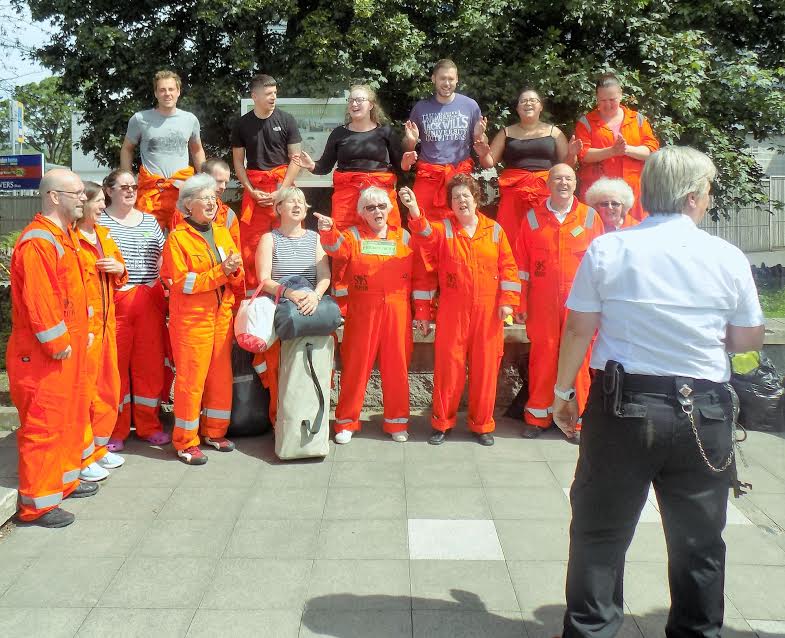
Local councillor banged up for 24 hours

All Chained Up 

Awaiting Release

Collared by Officer Kim Williams 

Freedom

On announcing my intention of going to prison to raise funds for charity, comments varied from ‘So, they’ve caught you at last!’ to, ‘How much do we have to pay to get them to keep you in?’

For those who have known me for any length of time such comments are hardly surprising. To tell the truth, I was ‘nominated’ by a friend and sentenced to 24 hours in Shepton Mallett prison for harassing her to go to pub quizzes. I can understand this; people either love or loathe quizzes.

The charity in question, SOS Africa, is a small charity, based in Shepton Mallett, set up in 2002 by a young man, Dr. Matt Crowcombe, after he saw first-hand the deprivation experienced by children in South Africa, and the negative impact this had on their life chances.

In order to be eligible to spend 24 hours locked up, those of us nominated were required to raise a minimum of £240 each, all of which goes towards providing educational support for a small group of children; this includes uniform, books, tuition, after care clubs with a hot meal, transport and family support, until the child reaches the age of 18, and is then eligible for government funding to go on to further education.

What really impressed me is that, unlike other charities, all of the monies raised go towards the project, with donations of equipment and other resources actively sought. Any salaries come out of the gift aid claimed on donations.

I am always up for doing something different so I really looked forward to the challenge, if for no other reason than that the prospect of 24 hours locked in a prison cell, with no-one able to communicate with me, seemed really appealing.
Surprisingly, we spent very little time in our cells.

Expecting meagre rations, I dashed off to ‘The Hive’ for a slap up cooked breakfast, one of the best I have ever had. After donning our orange boiler suits, my group of 15 were chained up and marched through the town, in silence, to the beat of a drum. Our Head Prison Officer Kim Williams, had in fact been an officer at the prison before its closure 2 years ago.

I was in Cell 6 of C block. The regime was not as harsh as I had been expecting, although I did find a number of things unsettling, principally that we lacked any control over our movements, completely at the mercy of others; not something I am at all comfortable with.
Our cells, which thankfully were single ones, were in a very poor state of repair. There was a toilet and wash basin, but neither were plumbed in, and there was electricity only in the communal areas. I did not mind using the portaloos, but I did mind that we had no freedom to visit when we wanted to, and that it was 47 steps to get up and down from my cell; by the end of my incarceration my knees were killing me! Furnishings consisted of an iron bed, and nothing else. Although I had brought a camping mattress, I found that sleeping directly on the iron bars was actually much more comfortable. Our list of permissible items meant that I had left the house with no keys, no phone, no identity; altogether a very unsettling experience.

The other aspect of being ‘locked up’ I found disconcerting was that we had no idea of the time. When we were shut up in our cells we had no idea how long it would be for, and when we were marched out we had no idea where we were going or what we would be doing.
Thankfully we were fed, and the majority of the time we spent in prison was taken up with a range of organised activities, including sewing pencil cases for the children, and learning their national anthem in Afrikaans during a singing lesson.

The following morning I did not so much mind being woken at 6am by what sounded like a fog horn, but I cannot say that I enjoyed the hour in the gym that followed it. 

Was it a worthwhile cause? Undoubtedly. Would I do it again? Like a shot

Wednesday, 7 June 2017

Samaritans Volunteer Tara is off to Invictus!


Tara Robertson, has been a listening volunteer for five years and is also Deputy Director for caller support at Samaritans of Taunton & Somerset. She is off to Toronto for the Invictus Games in September. 

There are just 90 members in the UK team and Tara has been selected to take part in the cycling events.  She is a keen athlete and competes regularly in triathlons and has also cycled the 1,004 miles, John O’Groats to Land’s End route in a fundraising effort for Samaritans, raising nearly £1,800. She has also raised money in several half-marathons.

More hopefuls than ever before, 306 wounded, injured and sick military personnel and veterans, trialled 11 sports for one of the 90 places available on the UK team. The rigorous selection process was based on the benefit the Invictus Games will give an individual as part of their recovery, combined with performance and commitment to training.

Invalided out of the army after being wounded in a bomb blast in Northern Ireland, Tara is thrilled to be representing the UK in Toronto.  “It is all a great experience, said Tara, “the training and selection was somewhat brutal but they have to take the best they can. I feel very honoured and privileged to be a small part of the team.  Now all I have to do is perform to my utmost.”


The UK delegation to the Invictus Games Toronto 2017 is being delivered by a partnership comprising The Ministry of Defence, Help for Heroes, and The Royal British Legion.  Jaguar Land Rover is proud to support the UK Team, and are presenting partners of the Invictus Games Toronto 2017.

Tuesday, 6 June 2017

The Ilminster Literary Festival & Ilminster Midsummer Experience

(Felix tucking into a good book)

As an incomer, albeit of some 30 years standing, I find that one of the joys of living in Somerset is the ready access to our vibrant market towns and the variety they offer. During the summer months we really are spoilt for choice with the many activities, often free, that help to put towns like Ilminster firmly on the cultural map.

June in particular, is an exciting time for Ilminster residents, attracting an influx of visitors keen to enjoy what is on offer at the town’s two ‘must see’ events. The month kicks off with The Ilminster Literary Festival (31st May – 8thJune), now in its second year, and hot on its heels, Ilminster Midsummer Experience (8th – 11th June), which is celebrating its 10th anniversary.

This year the Ilminster Literary Festival will feature 35 events held in a variety of venues in and around the town. National authors include Rosie Millard, Terry Waite and Paddy Ashdown, whilst local interest comes in the form of Capability Brown landscapes, cookery, historical sagas, children’s story telling, and of special interest to me, wine tasting.  Adult and children’s workshops are taking place for illustrating, poetry and creative writing. There really is something for everyone as the action-packed programme, which is readily available throughout the town, is filled with events that will appeal to both children and adults, and the young at heart; not having any children myself did not stop me queueing up last year for a signed, illustrated, copy of Petr Horacek’s lovely Blue Penguin book.

As a keen quizzer, I am once again looking forward playing the role of quiz master at the Literary Festival Quiz. If last year is anything to go by we shall have to get a bigger venue next year!

Some of the events include light refreshments, a traditional Somerset cream tea or lunch. Tickets are being snapped up, so be sure to book yours soon via the festival website. www.ilminsterliteraryfestival.org  or email: ilminsterlitfest@gmail.com

We will all have had barely enough time to draw breath before the start of the 4 day Ilminster Midsummer Experience, which has now become a major attraction for visitors coming from across the South West and beyond. A couple of weeks beforehand will see the erection of over 100 colourful flags throughout the town, including stunning banners designed by Patrick Reyntiens in the Minster churchyard. With over 25 events during the festival there is sure to be something for everyone to enjoy. In addition to plays, concerts and art exhibitions, there will be a fascinating Food and Craft Market on Saturday 10th. The following day will see the town host a large Classic Car Show, a Fun Dog Show, Fun Fair, Brass Band concert, and delicious food served in a Food Court, as well as the popular community lunch hosted once again by the Rotary Club of Ilminster. This year there will be a Somerset theme to the lunch, with yummy, scrumptious produce from local suppliers and producers. 

Ilminster is also proud of being a Fairtrade town, with their mantra ‘If you can’t buy local buy Fairtrade’. Put simply, it means a commitment to treating producers fairly, whether it is the local farmers who supply our milk, meat and cereals, to the tea and coffee growers in the developing world. As consumers, we all have the power to change the world each and every day. When we make even simple shopping choices we can help farmers to get a better deal meaning they can make their own decisions, control their futures and lead the dignified life everyone deserves. Local businesses benefit too, and having Fairtrade Town status adds one more string to the bow of our blossoming tourist industry. It gives the growing number of people who are concerned about the ethics of trade a reason to visit Ilminster and the surrounding countryside; increased visitor numbers mean more trade for everyone.

Of course, none of this happens by chance. It is the hard work over many weeks and months by dedicated teams who really do want to make a difference. How many more reasons do we need to visit this lively town…. no wonder so many people choose to settle here. 

Monday, 5 June 2017

Ramadan and the effects of fasting


Whilst there can never be any excuse for the atrocities we have recently seen committed in the name of Allah, a talk given by Terry Waite, that I attended this week as part of Ilminster Literary Festival’s programme of activities, highlighted the fact that we need to look beyond the action and see the wider picture. It is only then that we can hope to understand what is the root cause behind such actions, and then find a solution.

In the wake of the latest slaughter there has been some focus on the fact that Ramadan is considered to add a piquancy to such actions, but what we must also consider is the effect that fasting has on the cognitive ability of those who do so. I was sufficiently interested to look at a study carried out by the Asian Journal of Sports Medicine. This showed that well-documented effects of Ramadan fasting include, amongst other things, physical and cognitive performance. To put this into context, we all know the effect that hunger can have on children, their behaviour, and their performance at school.

This, coupled with the extreme radicalisation of young Islamic men, brought about by a high level of tolerance and political correctness, and the failure of our efforts at integrating immigrants into our way of life, has meant that their activities have so far gone largely unchecked.

I agree that prevention is the key to avoiding the repetition of events that we have seen in recent weeks, but until we have a greater understanding of why people choose to behave in this way then we will be less likely to succeed.

I know from my own work with troubled youngsters that the only way to effectively turn their lives around is to put myself in their shoes, and not to allow my own prejudices to get in the way of progress.